
Local Services Ads (LSAs), Google Ads, and the Local Pack each play a different role in home services marketing. WebFX’s 2026 study analyzed 100 keywords across five home service industries to determine which channel appears most often, when each one dominates search results, and how these channels impact visibility.
The study pulled real search data across HVAC, plumbing, roofing, electrical, and garage door queries to measure which features appear, how often they appear, and where they land on the page. Here are the findings.
To compare the visibility of Local Services Ads, Google Ads, and the Local Pack, 100 U.S. home services keywords across five verticals were studied: HVAC, plumbing, roofing, electrical, and garage door services. Each keyword was run five times through a third-party search engine results page (SERP) data provider, for a total of 500 searches, to measure which features appeared, how often they appeared, and where they landed on the page.
Local Services Ads (the pay-per-lead units with the Google Verified badge), traditional Google Ads (the sponsored pay-per-click results), and the organic Local Pack (the map-based block of local business listings) were tracked.
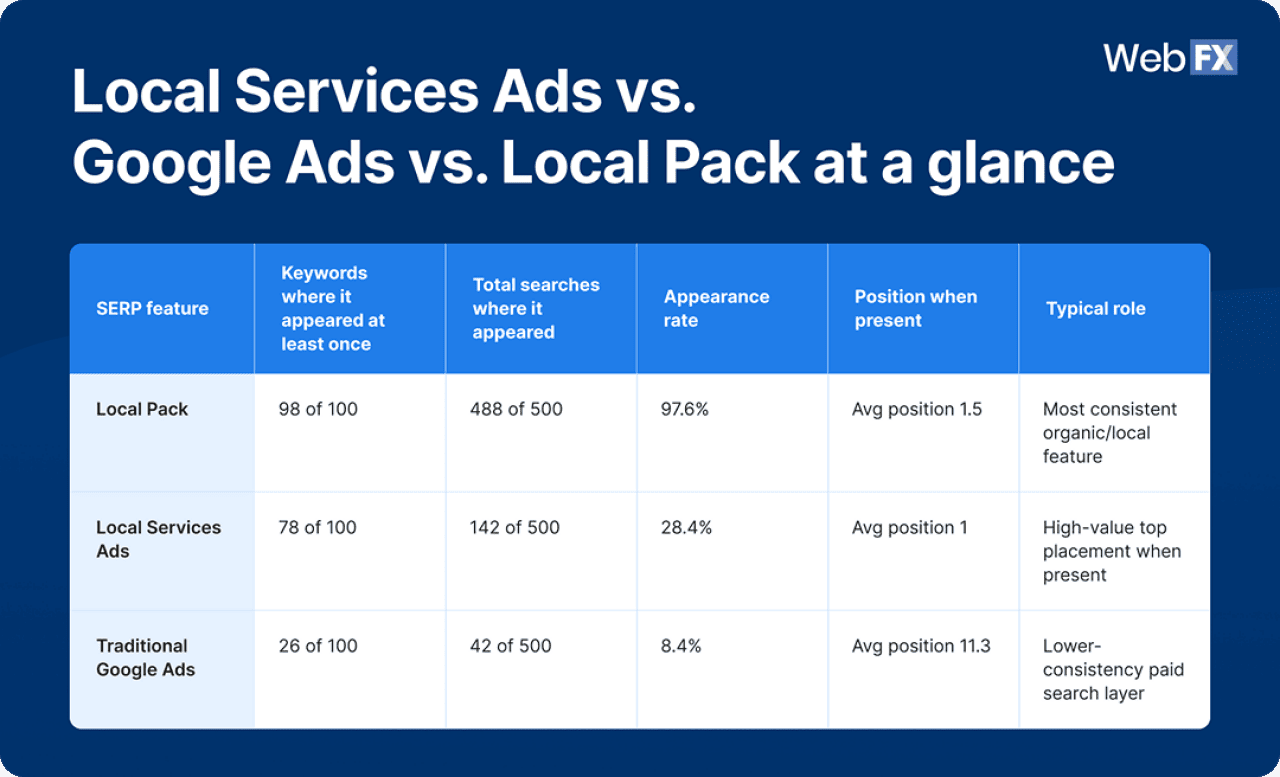
Here is the topline at a glance:
The rest of this study breaks down what each row means for search visibility.
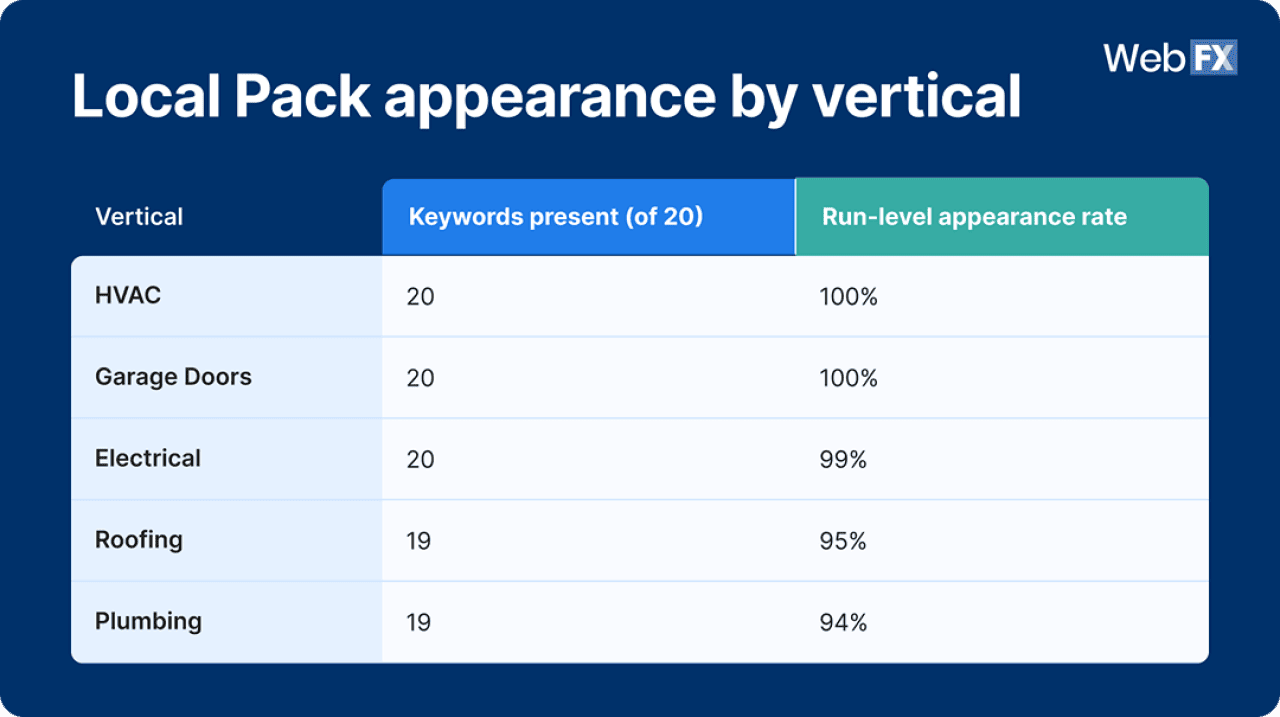
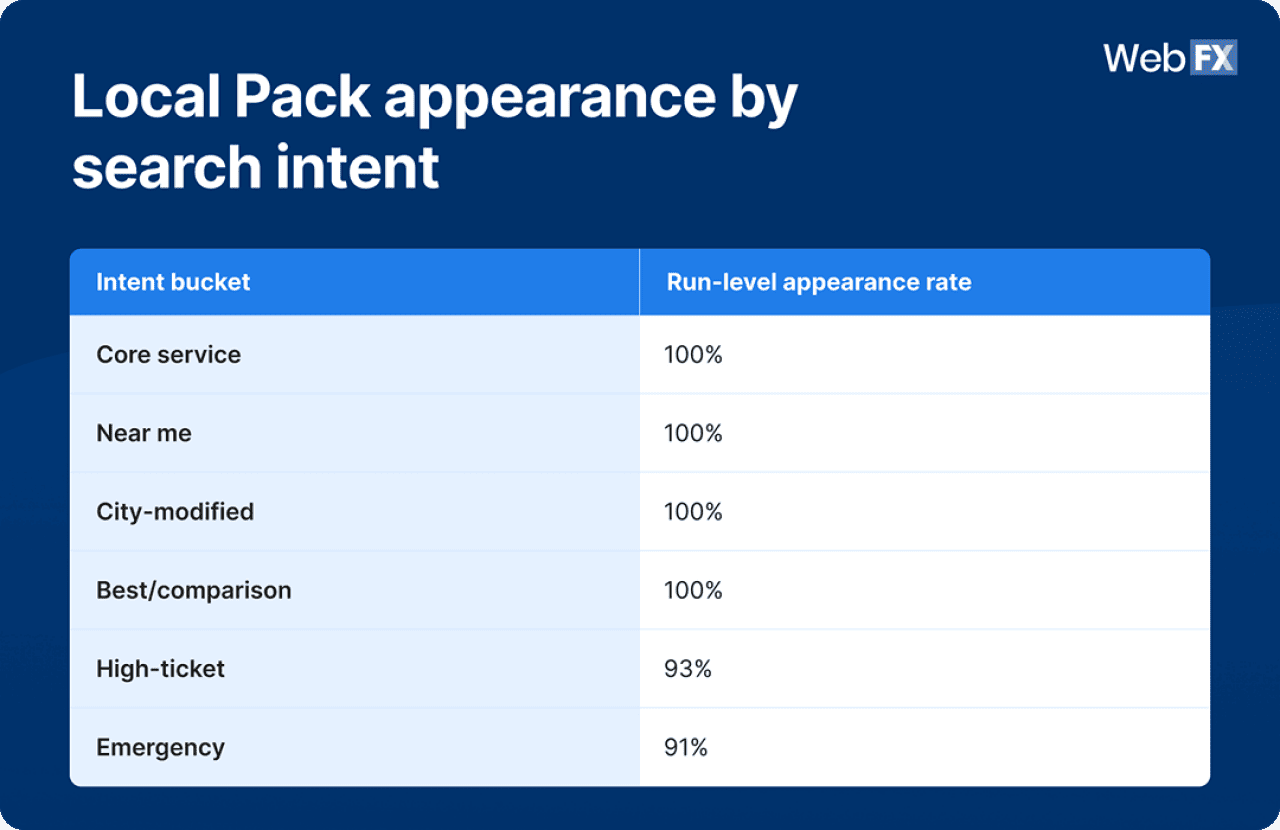
The Local Pack is the most consistent feature on home services search results, appearing on 98 of 100 keywords studied and in 488 of 500 searches (about 98%). No other feature comes close to that reliability.
What this means for your budget:
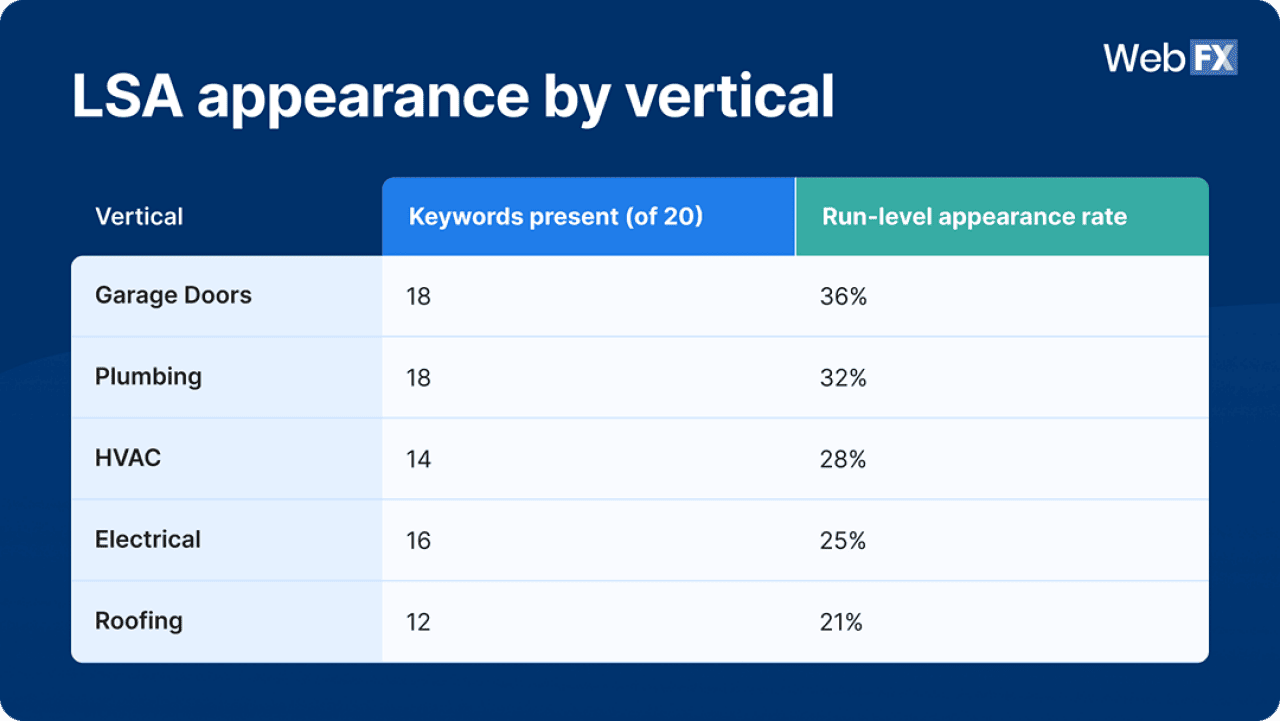
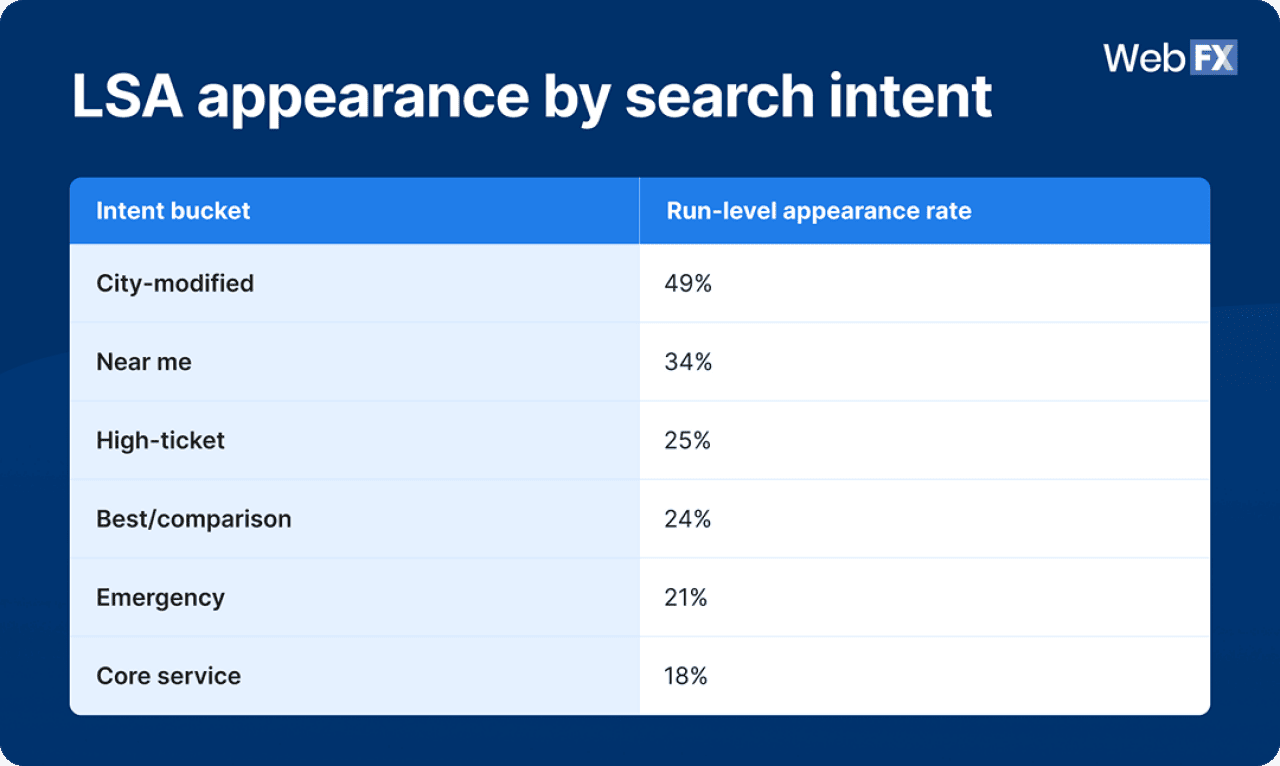
Local Services Ads appeared at least once for 78 of 100 keywords, but in only 142 of 500 searches (about 28%). LSAs are eligible for most home services keywords, yet they do not show on every search the way many marketers assume.
What this means for your budget:
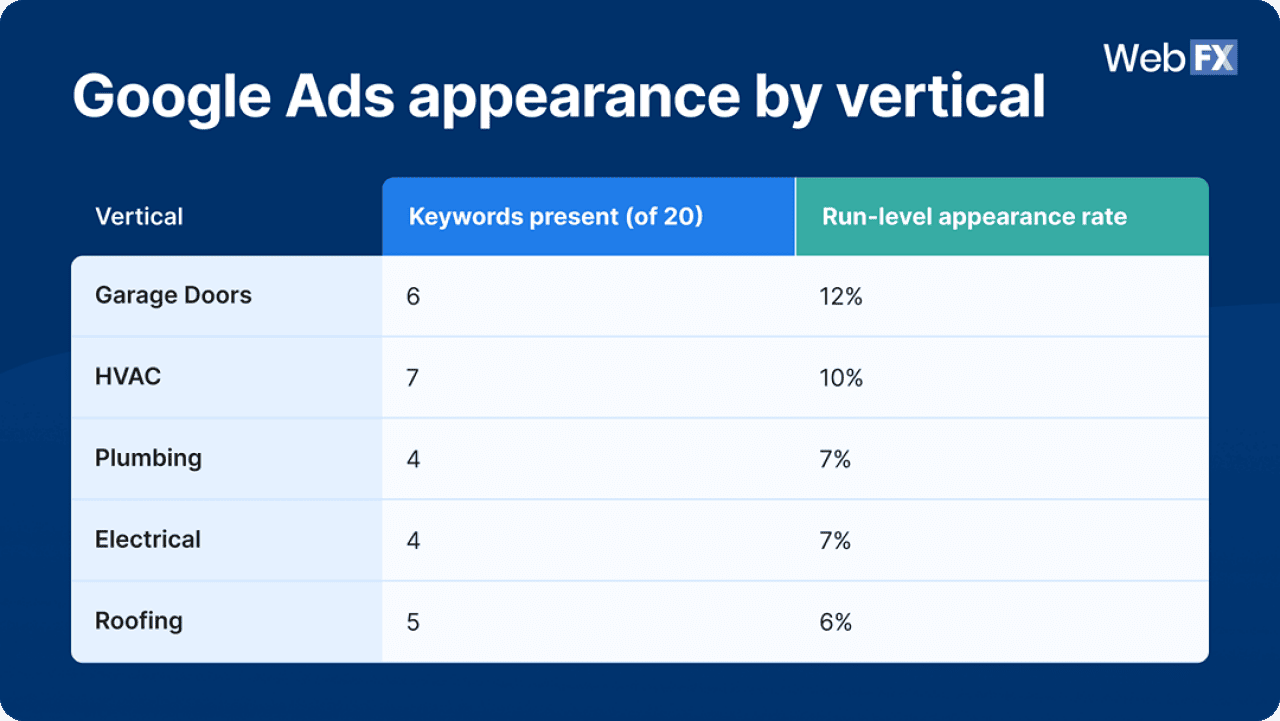
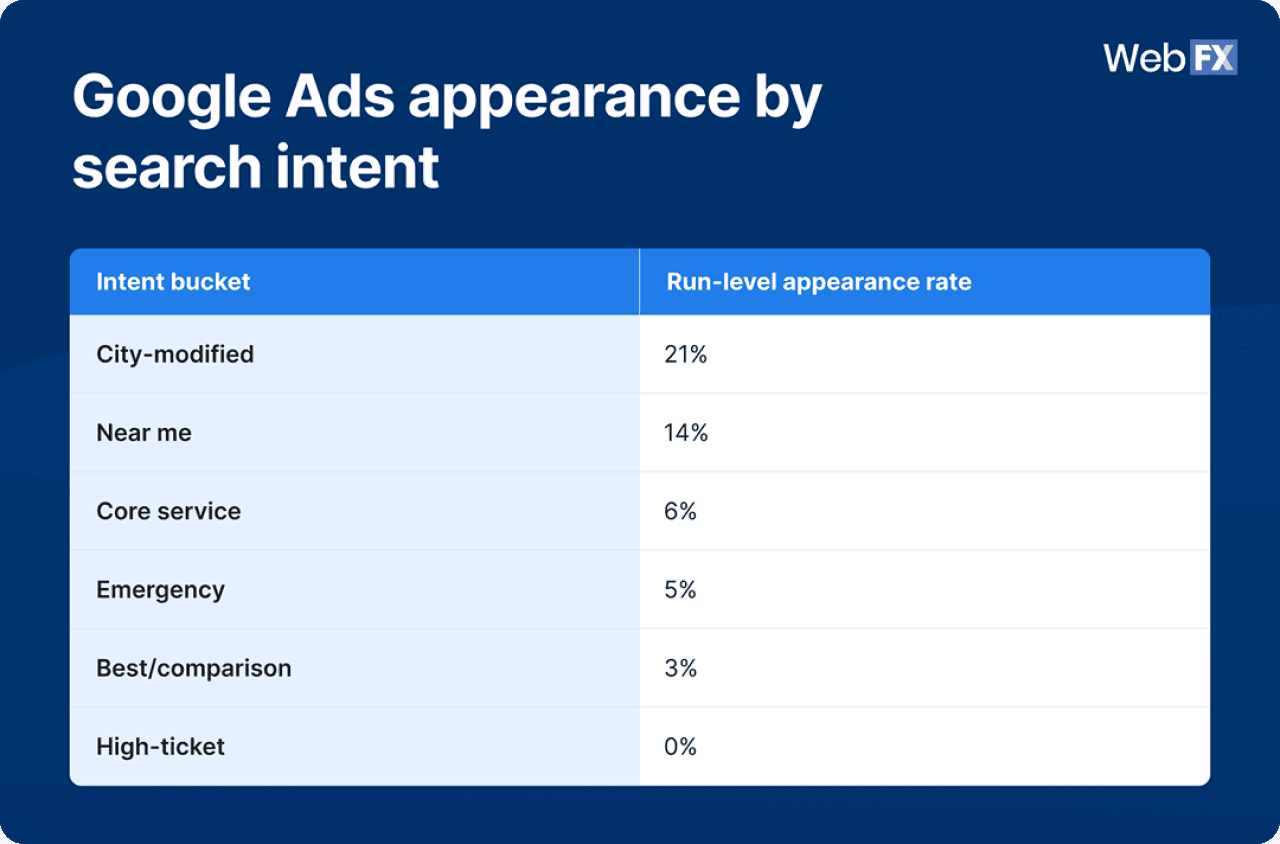
Traditional Google Ads appeared on just 26 of 100 keywords and in only 42 of 500 searches (about 8%), making it the least visible of the three features by a wide margin. For a channel many home services businesses treat as their default, these sponsored search ads showed up far less than expected.
What this means for your budget:
The order that features appear tells you more than whether they appear at all. Across the 500 searches conducted, the top of the home services SERP came down to a contest between two features: Local Services Ads when they appeared and the Local Pack when they did not. Traditional Google Ads rarely entered the picture at the top.
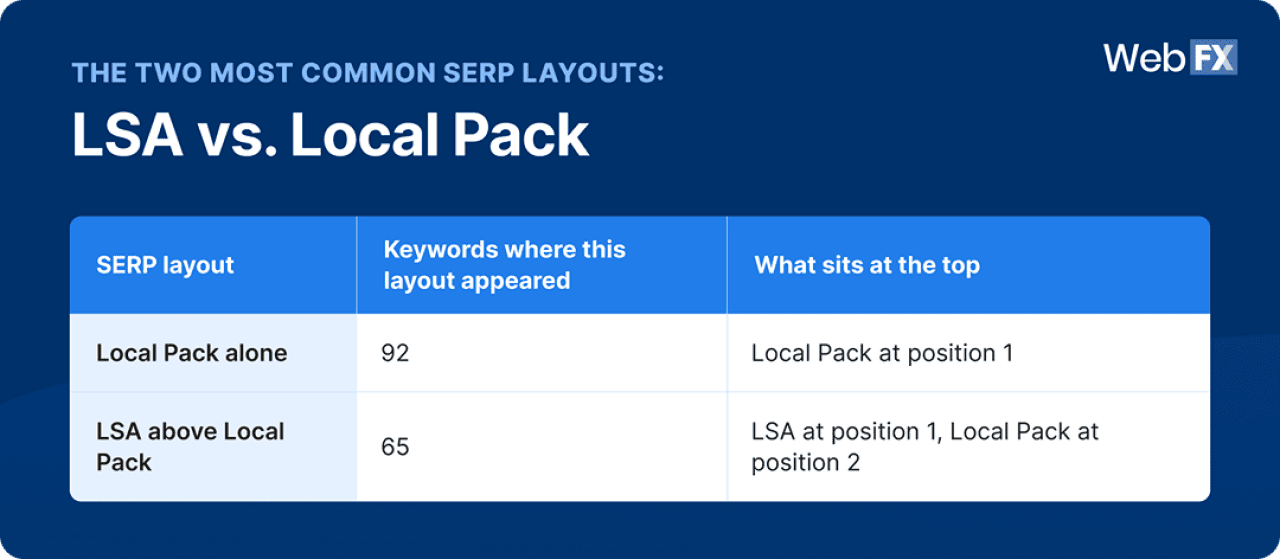
Note: Layout counts can overlap because the same keyword can show different SERP layouts across repeated runs.
Two facts define the top of the page:
So the question at the top of a home services SERP is rarely “ad or organic.” It comes down to LSA versus Local Pack. In the Google Ads versus Local Pack matchup, sponsored ads rarely reached the top, landing lower on the page than either.
This reframes the budget question. If the top of your SERP is a two-horse race of LSA versus Local Pack, your first two priorities are clear: Visibility priorities include earning placement in the Local Pack through local SEO and utilizing LSAs. Google Ads still matter, but they compete for lower real estate, which is exactly why they belong in a supporting role.
Based on visibility alone, home services businesses should prioritize local SEO to win the Local Pack, layer in Local Services Ads where they appear consistently, and use Google Ads as a targeted support channel. The data point to a clear order of priority because the three features do not provide equal visibility.
The order matters more than any fixed budget split. Your exact mix depends on your market, your current visibility, and how often LSAs appear for the searches that matter to you. Here is how to think through it.
The Local Pack appeared in 488 of 500 searches, so this is the visibility you cannot afford to skip. Because it is earned through local SEO rather than paid for, it also delivers the most durable return: Once you rank in the map block, you keep showing up without paying per click or per lead.
To compete for the Local Pack, focus on the signals Google rewards:
If you are not appearing in the Local Pack for your core services, make that a priority before you rely too heavily on paid channels. Otherwise, you are paying to compete for lower-visibility placements while the feature customers see most often shows up without your business in it.
Local Services Ads earned the top position in every search where they appeared, so they are worth capturing, but only where they show up often enough to justify the spend. Since LSAs appeared in about 28% of searches overall and nearly 49% of city-specific searches, their value depends heavily on your market.
Check how often LSAs appear for your highest-intent keywords in the cities you serve. Where they appear regularly, especially in defined metros, LSAs are a strong investment because they put you above everything else on the page. To capture them:
Demand also shifts across the year, so the months when LSAs are worth the most spend often line up with seasonal search shifts in home services demand like peak HVAC season or post-storm roofing surges.
Traditional Google Ads appeared in only about 8% of searches, so they are not your visibility foundation, but they give you control that the other two features cannot. Use them for specific jobs rather than broad service capture:
Deployed this way, Google Ads complements your local SEO and LSA presence instead of competing with them for the same budget.
In the most competitive home services searches, all three features appear together. Across the study, 22 of 100 keywords showed an LSA, a sponsored ad, and the Local Pack at least once. In those markets, a single-channel strategy lets competitors occupy the SERP from angles you are not covering.
If your priority keywords consistently show all three, the strongest approach is a layered one: Local SEO to anchor the Local Pack, LSAs to claim the top when they appear, and Google Ads to control the messaging and retargeting around both. The goal is not to spread your budget evenly but to make sure you are present at every level of a crowded SERP.
Data sources and methodology
The WebFX marketing team conducted this study in May 2026 to measure how often Local Services Ads, traditional Google Ads, and the organic Local Pack appear on home services search results, and where each feature lands on the page.
Data scope
This report analyzed 100 U.S. home services keywords across five verticals: HVAC, plumbing, roofing, electrical, and garage door services. Each vertical was represented by 20 keywords distributed across six intent buckets: core service, near me, city-modified, emergency, high-ticket, and best/comparison queries.
Keyword selection
All 100 keywords were validated through Ahrefs and selected to reflect real home services search behavior. Keywords were chosen for commercial or transactional intent, with all carrying a monthly search volume of 500 or higher and a keyword difficulty of 30 or higher. The set includes a strong mix of near-me, emergency, and city-specific queries to match how customers actually search for home services providers.
Data collection
For each keyword, SERP data was retrieved from a third-party provider. Each keyword was queried five times, for a total of 500 searches, to account for the variability in how SERP features appear from one search to the next. Each search was pulled at a depth of 20 results to capture features that appear lower on the page.
Local Services Ad detection was pulled directly from a SERP feature object rather than inferred from page structure, which gives high confidence in the LSA presence and provider data. Traditional Google Ads were captured through the sponsored results feature, and the Local Pack was captured through the map-based local results feature.
Sponsored results were captured across the full requested 20-result depth, not just top-of-page placements, so the low Google Ads appearance rate is not a result of limited capture. It more likely reflects how often Google surfaces traditional sponsored ads on these local home services SERPs, where Local Services Ads and the Local Pack occupy most of the high-visibility space.
Location targeting was applied at the city level for city-modified keywords, using the city named in the query (Dallas, Houston, Phoenix, or Chicago). For all other keywords, New York was used as the default location to reflect a competitive local search environment.
Metrics captured
The following were recorded for each keyword across its five runs: feature presence, appearance rate across runs, maximum block and provider counts for LSAs, first-position minimum, maximum, and average for each feature, and the order in which features appeared on the page.
How to read the metrics
This study reports three distinct measures:
Limitations
This story was produced by WebFX and reviewed and distributed by Stacker.


